03-13-2026 |

The Revenue Estimating Conference (“REC”) met today as part of their standard schedule of meetings to estimate future state revenues. REC members Kraig Paulsen (Gov.’s Appointee), Jennifer Acton (LSA), and Jeff Plagge (Public Member) serve on the three-member panel. A summary of the information discussed during the meeting is below, along with the linked spreadsheet distributed at the meeting that contains more granular revenue information.
Summary:
Reminder, the Iowa Legislature is required to use the lesser of the December or March REC numbers for purposes of setting their upcoming budget for FY27. See 8.22A(3). Based upon today’s numbers, the legislature will be required to use today’s REC numbers outlined below.
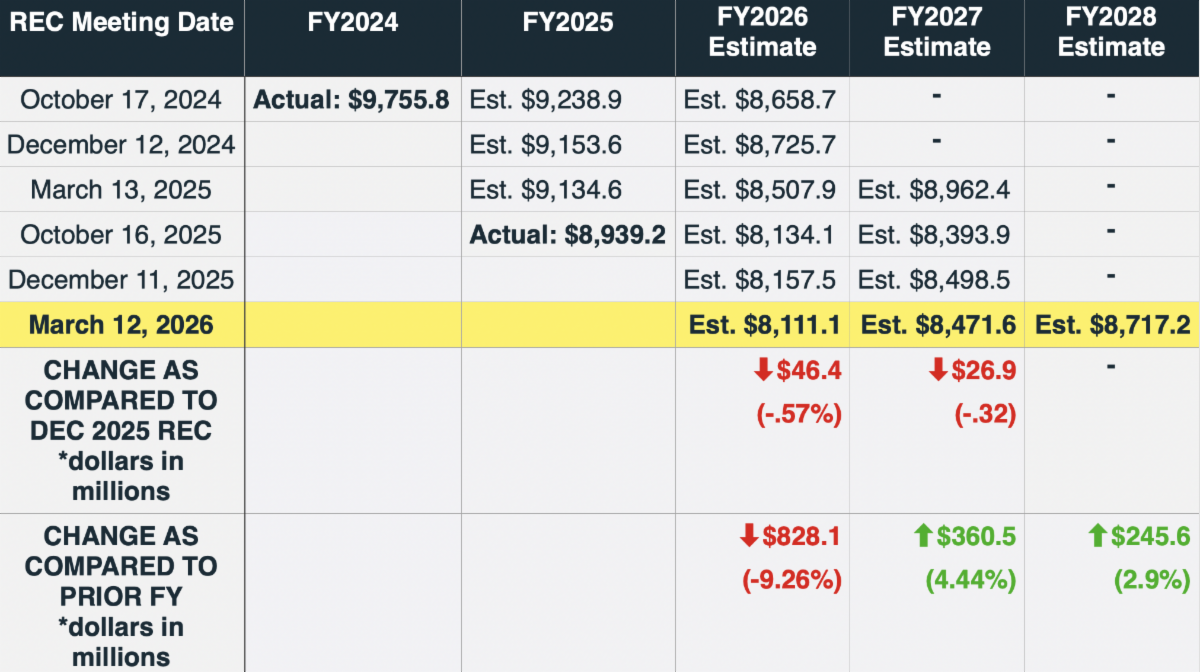
FY 2026 (began July 1, 2025): Thursday’s REC estimate for FY26 is lower than the December 2025 REC estimate by $46.4 million. The REC now estimates net receipts for FY26 will be $8,111.1 billion, which is $828.1 million (-9.1%) less than FY25 actual revenues.
FY 2027 (begins July 1, 2026): Thursday’s REC estimate for FY27 is lower than the December 2025 REC estimate by $26.9 million. The REC now estimates net receipts for FY27 will be $8,471.6 billion, which is $360.5 million (1.04%) more than the REC's FY26 estimated revenues.
FY 2028 (begins July 1, 2027): Thursday the REC introduced their estimated net receipts for FY28 of $8,717.2 million, which is $245.6 million (1.03%) more than the REC’s FY27 estimated revenues. It is of note, FY28 is 476 days away and this estimate will be adjusted many times over the coming meetings.
|
General Comments from the REC Regarding Factors Impacting Estimates:
- Global economic uncertainty has become an issue with the conflict in the Middle East; however the national economy has remained resilient despite the national GDP being down.
- Iowa’s unemployment rate remain steady; however, the national unemployment rate has increased and the labor market appears to be softening.
- Affordability continues to be an issue for retail consumers and homebuyers. Consumer spending remains flat and retail sales are down and tariffs continue to drive price increases. However, in Iowa, wage growth continues to stay strong and consumer spending has stayed steady.
- In agriculture, the Iowa agriculture economy has been stressed but stays stable while manufacturing has seen an uptick and the private sector has continued to invest in Iowa manufacturing.